
A strategy note · Clinton → Tyler & the RTA Store team
You're not just selling cabinets.You're selling confidence.
This is an honest outside perspective. I subscribed to your emails and walked the funnel as a real customer would — no dashboards, no internal context, just the experience a new lead actually receives. What follows is what I saw, why I think it works against you, and a strategy I'd love to build with you.
The premise
Your emails are loud.
Your customer is quiet.
One thing up front: this is a hypothesis, not a verdict. Everything here should be checked against your own numbers. If the data says otherwise, the data wins — and I want to see it.
The initial analysis · what I'm seeing from the outside
One offer, ten emails, six costumes.
Over roughly three weeks, a brand-new subscriber receives a stream of near-identical 'up to 60% off' promotions under rotating names — with deadlines that quietly reset.
- Jun 12ThuThe RTA Storeup to 60% offBlack Friday in June is BACK — up to 60% OFFOur biggest event returns. Save on every collection…
- Jun 15SunThe RTA Storeup to 60% off⏳ ends tonight⏰ ENDS TONIGHT: Up to 60% Off ends at midnightLast call — don't miss your chance to save…
- ↑ deadline resetJun 16MonThe RTA Storeup to 60% offExtended! Flash Sale — Up to 60% OffYou asked, we listened. A few more days to save…
- Jun 19ThuThe RTA Storeup to 60% off⏳ ends tonight24 HOURS ONLY: Boost Sale up to 60% OffOne day only. This deal disappears at midnight…
- Jun 20FriThe RTA Storeup to 60% off⏳ ends tonightLAST CHANCE — Boost Sale ends tonightFinal hours to lock in your savings…
- ↑ deadline resetJun 23MonThe RTA Storeup to 60% offNew: Summer Savings Event — Up to 60% OffA fresh way to save on your dream kitchen…
- Jun 27FriThe RTA Storeup to 60% off⏳ ends tonightFINAL HOURS ⏰ Up to 60% OffThis is it — savings end at midnight tonight…
- ↑ deadline resetJul 1TueThe RTA Storeup to 60% offIndependence Day Sale — Up to 60% OffCelebrate with savings on every collection…
- Jul 3ThuThe RTA Storeup to 60% off⏳ ends tonightEnds Tomorrow: July 4th Savings up to 60%The holiday event won't last — save before it's gone…
- ↑ deadline resetJul 5SatThe RTA Storeup to 60% offEncore: Independence Day Extended up to 60% OffBack by popular demand — a little more time to save…
Reconstructed from a real ~3-week subscription window. Subject lines paraphrased; the pattern is exact.
The pattern · Same discount, rotating costumes. 'Ends tonight' on one day is followed by a brand-new sale — at the same 60% — the next. The deadline never actually arrives.
Through the customer's eyes · the actual sends
This is what actually landed in the inbox.
Not a mockup — these are the real emails a single subscriber received, shown together the way a customer experiences them. Seen one at a time, each seems fine. Seen as a wall, the pattern is impossible to miss.
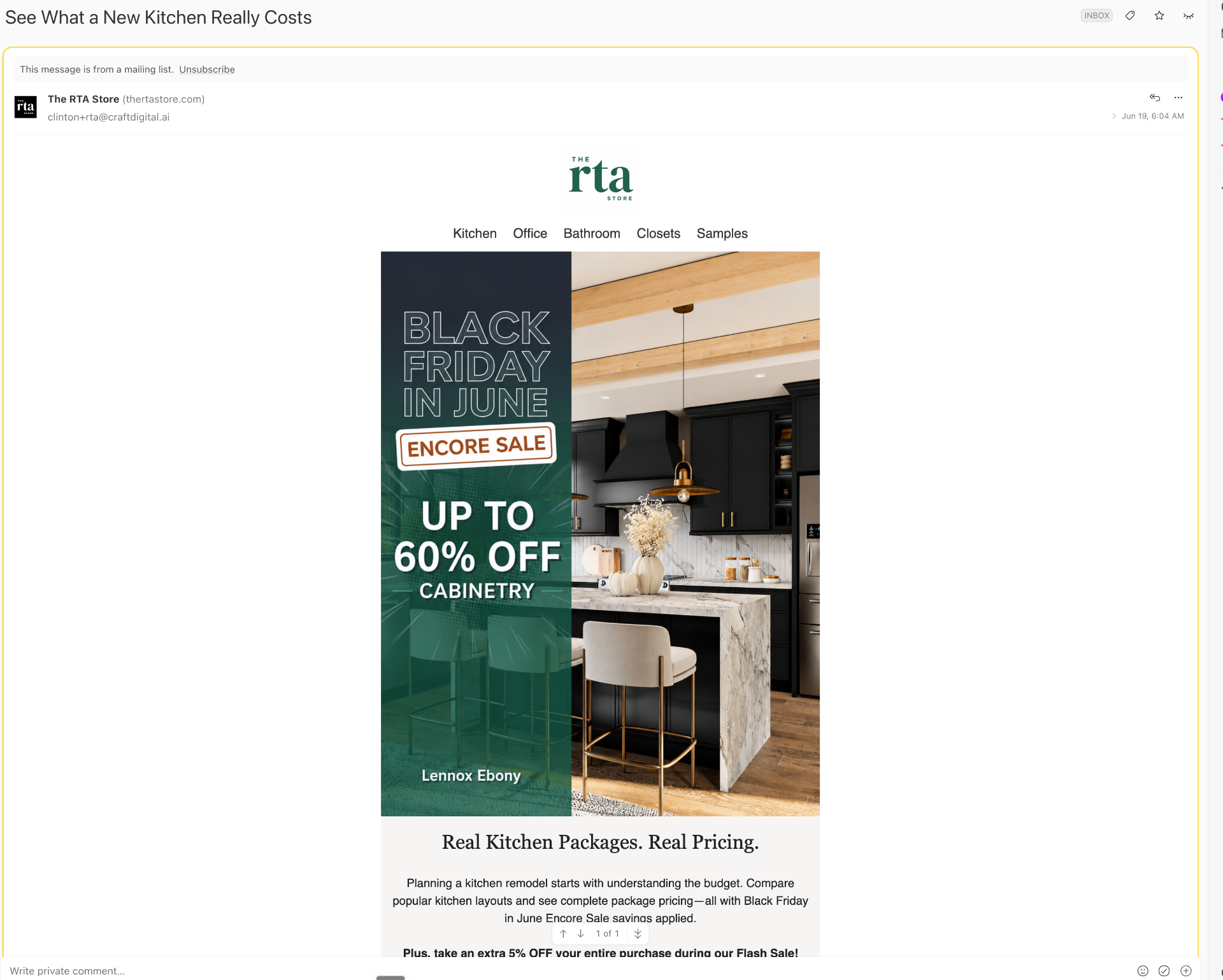
See What a New Kitchen Really Costs
Promotion · up to 60% off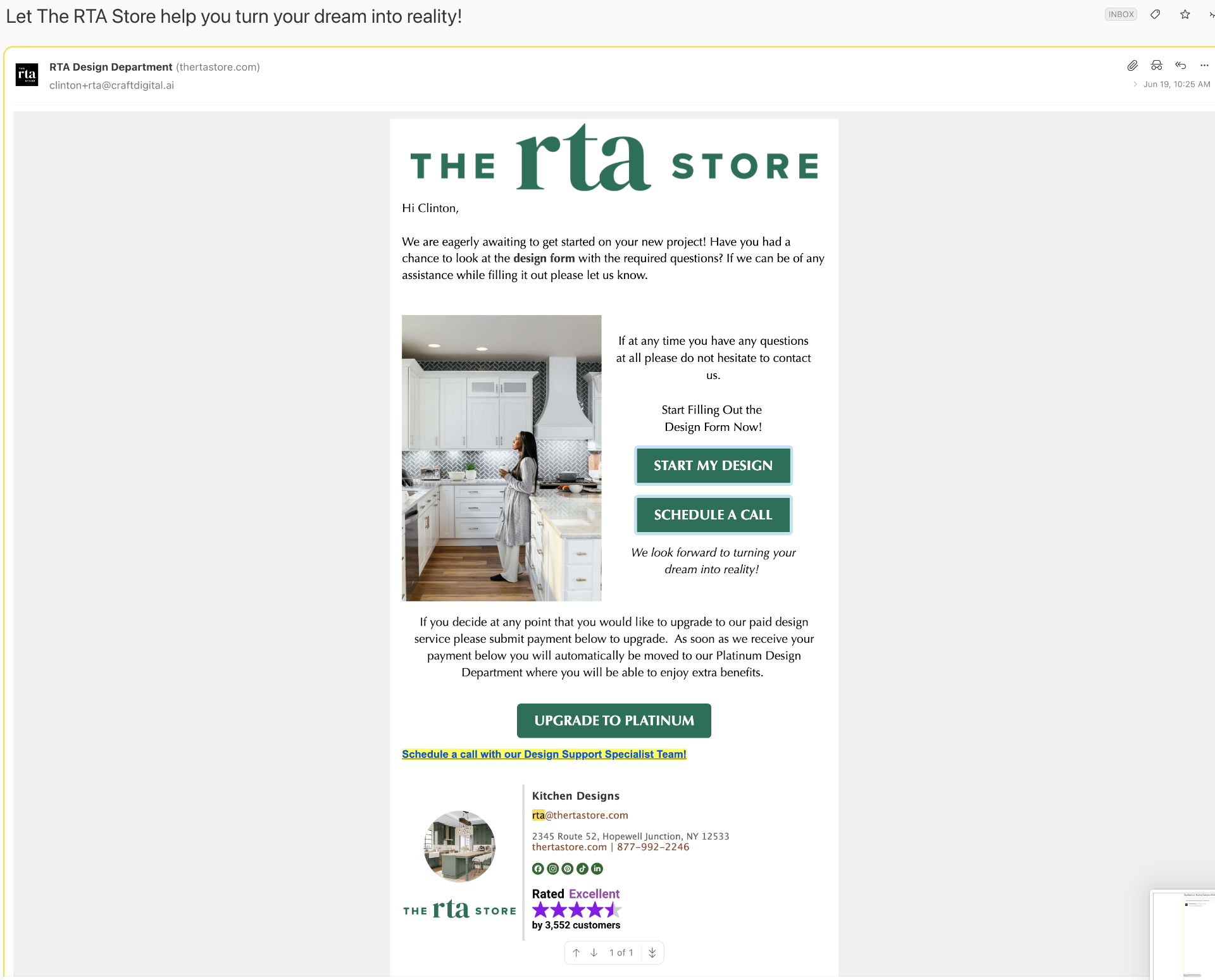
Let The RTA Store help you turn your dream into reality!
Relationship / design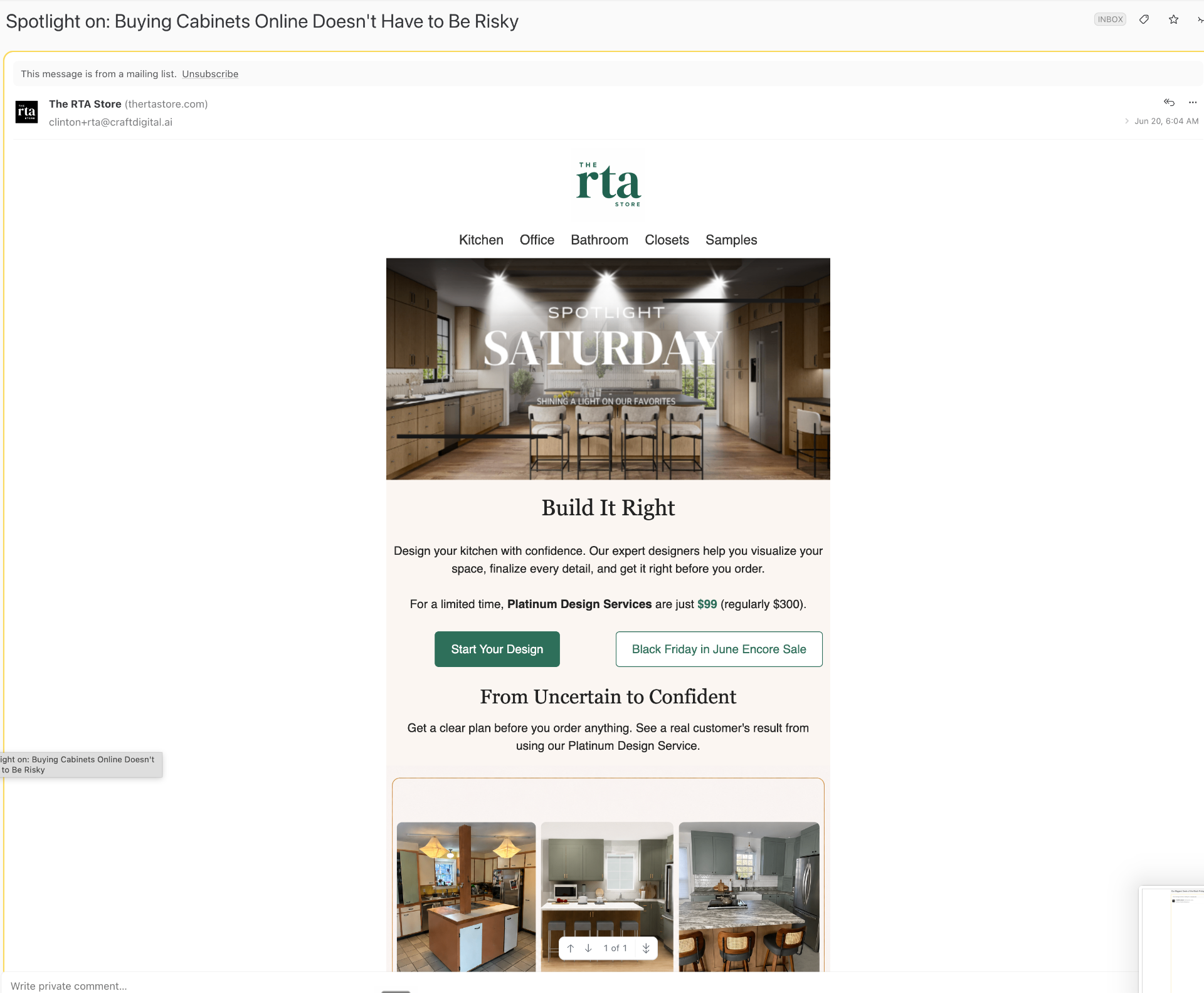
Spotlight on: Buying Cabinets Online Doesn't Have to Be Risky
Relationship / design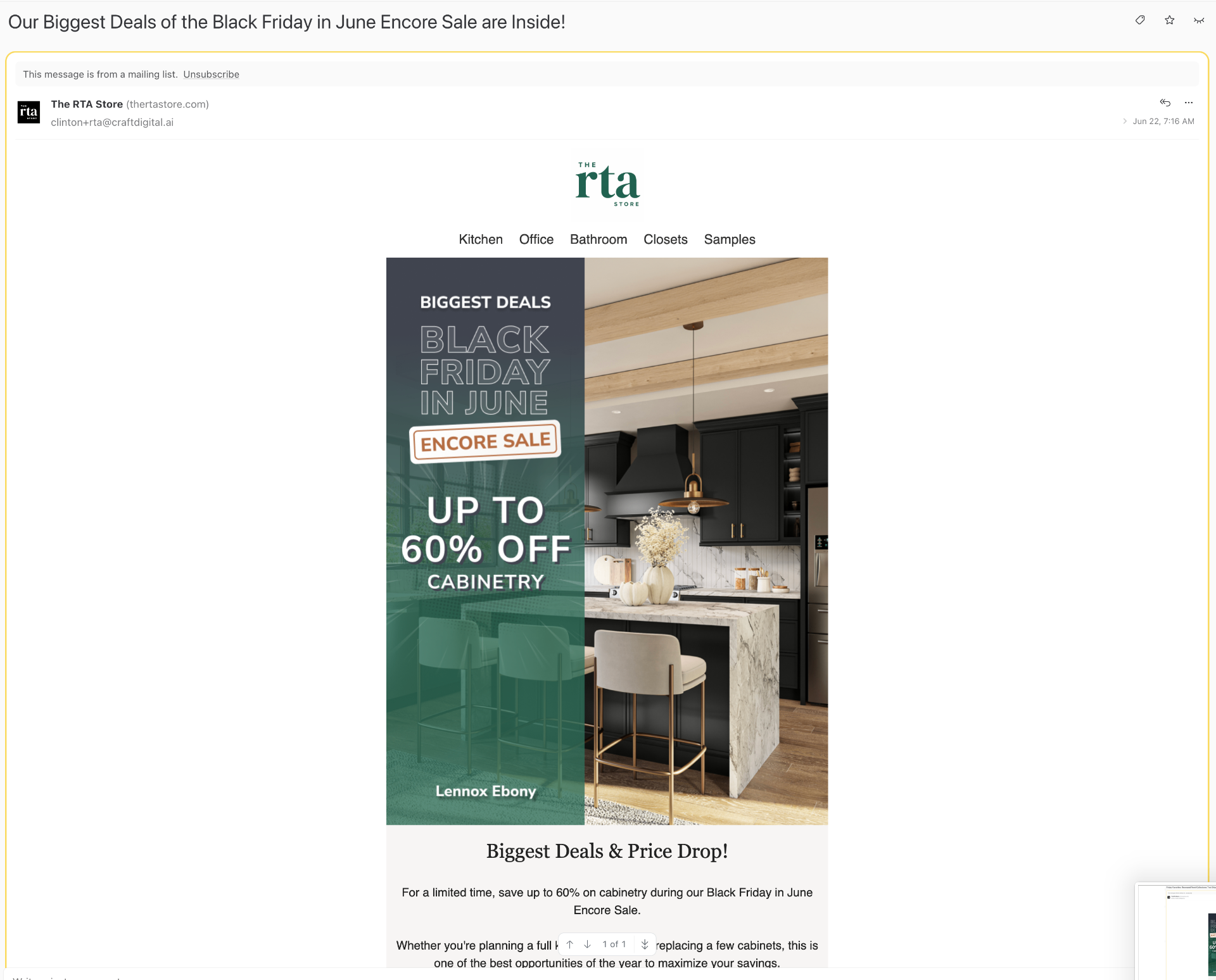
Our Biggest Deals of the Black Friday in June Encore Sale are Inside!
Promotion · up to 60% off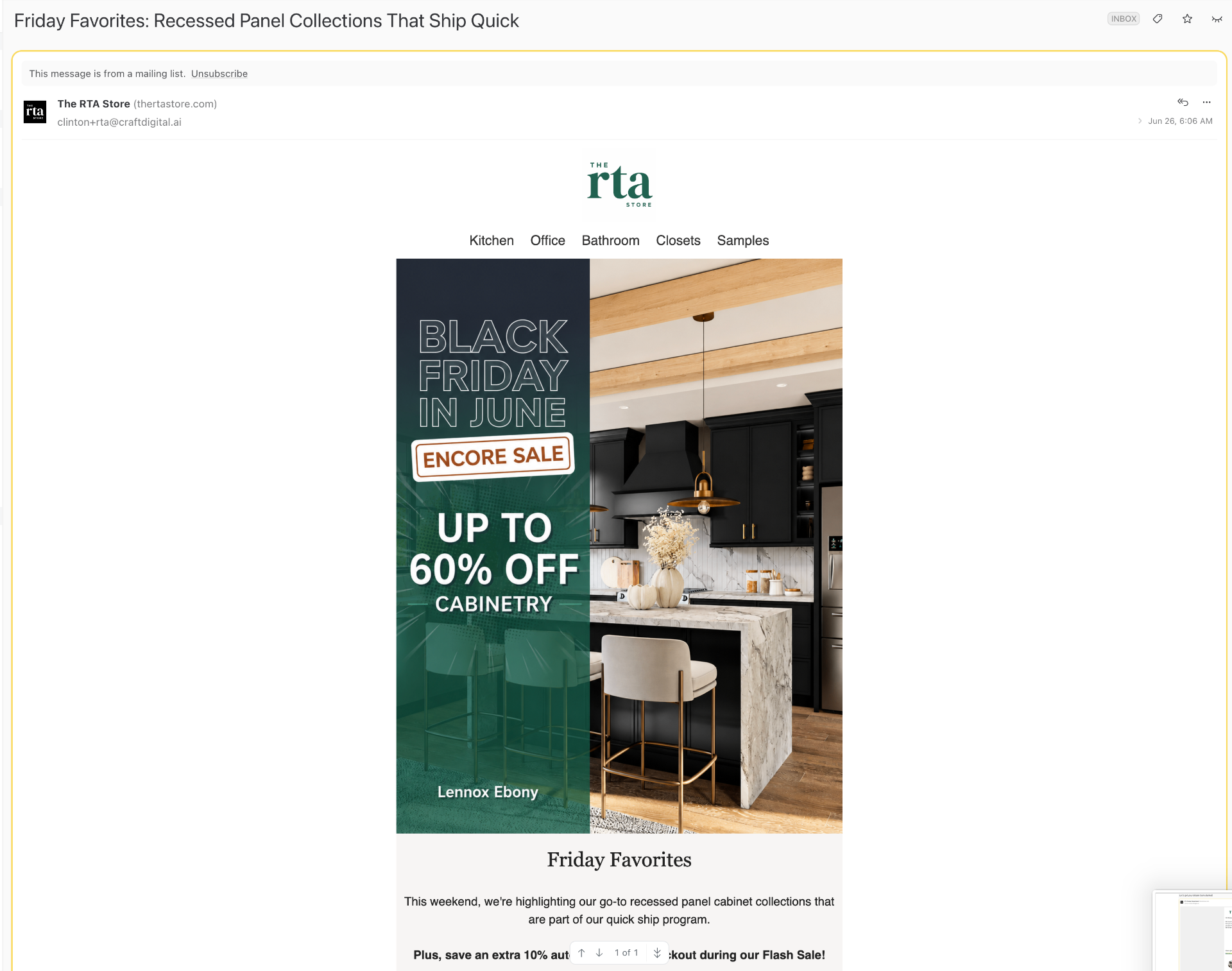
Friday Favorites: Recessed Panel Collections That Ship Quick
Promotion · up to 60% off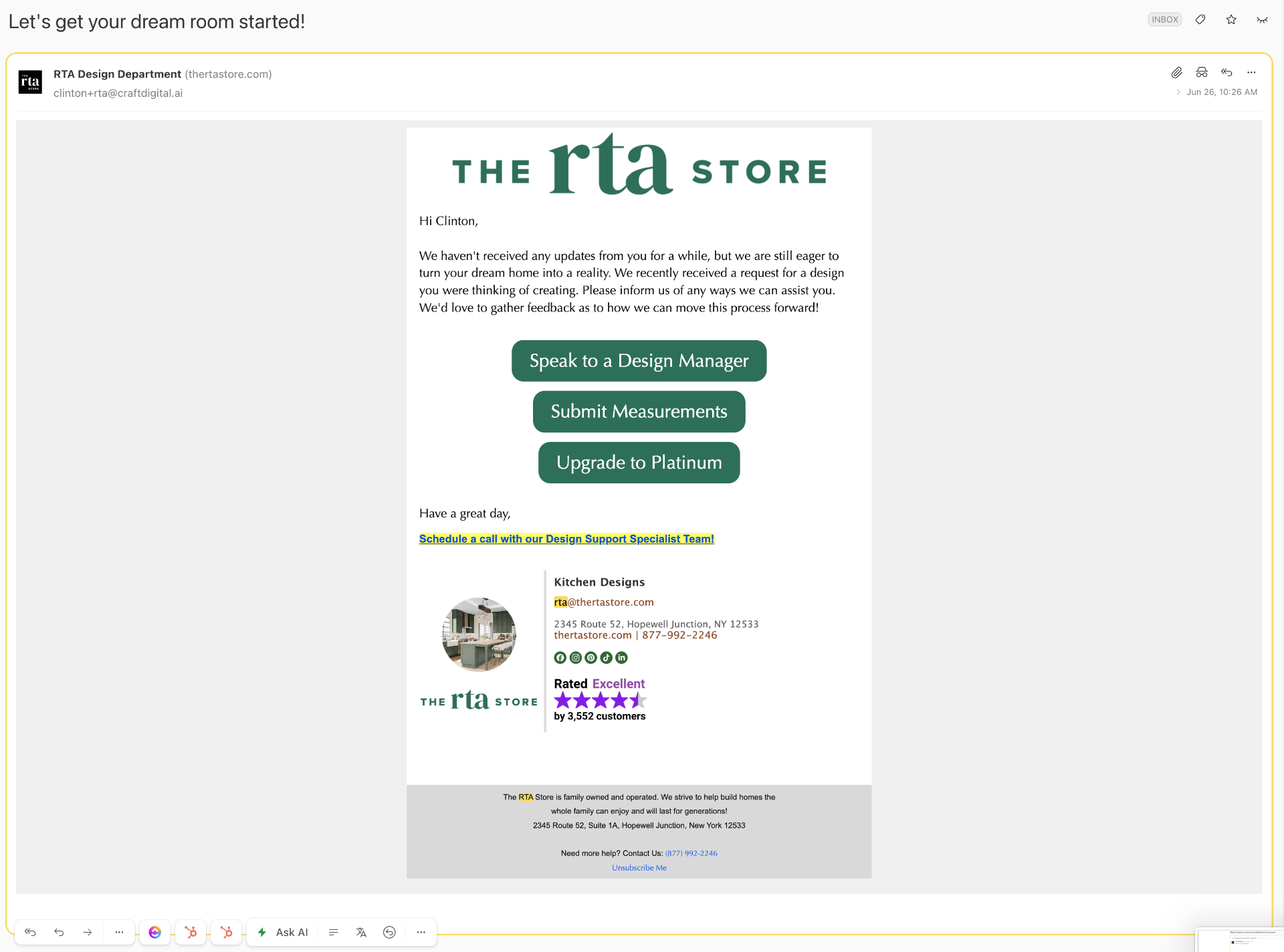
Let's get your dream room started!
Relationship / design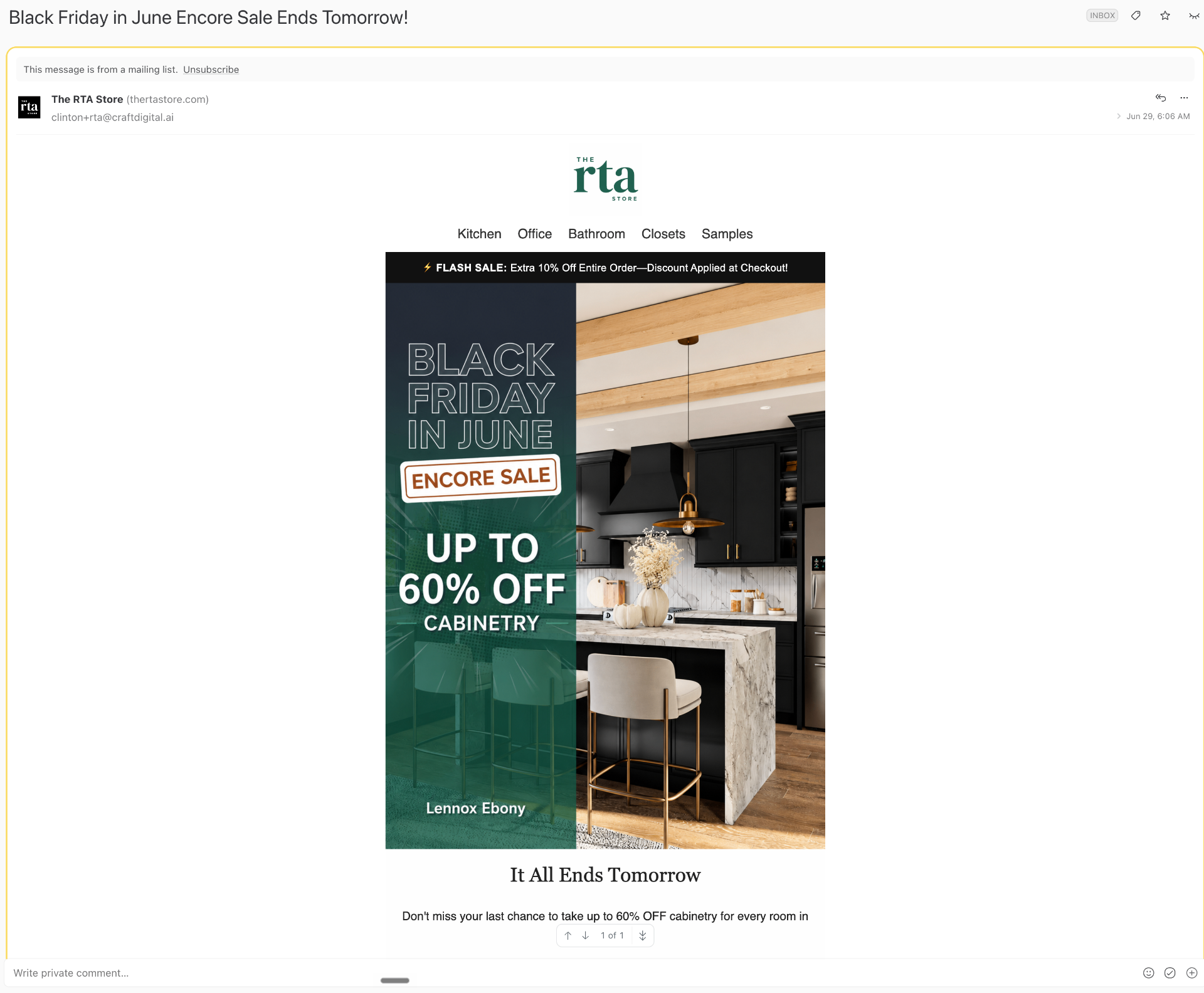
Black Friday in June Encore Sale Ends Tomorrow!
Promotion · up to 60% off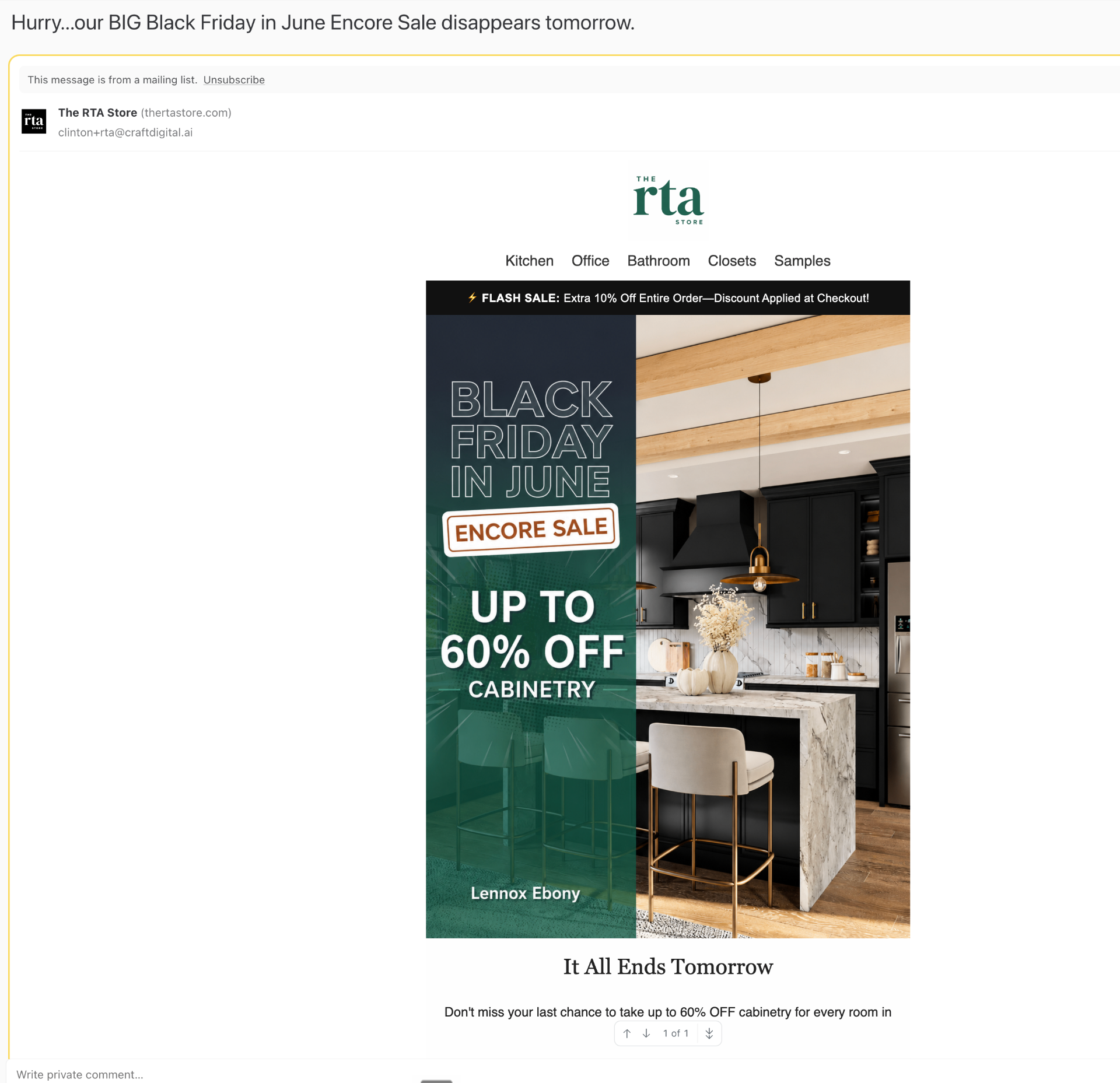
Hurry…our BIG Black Friday in June Encore Sale disappears tomorrow.
Promotion · up to 60% off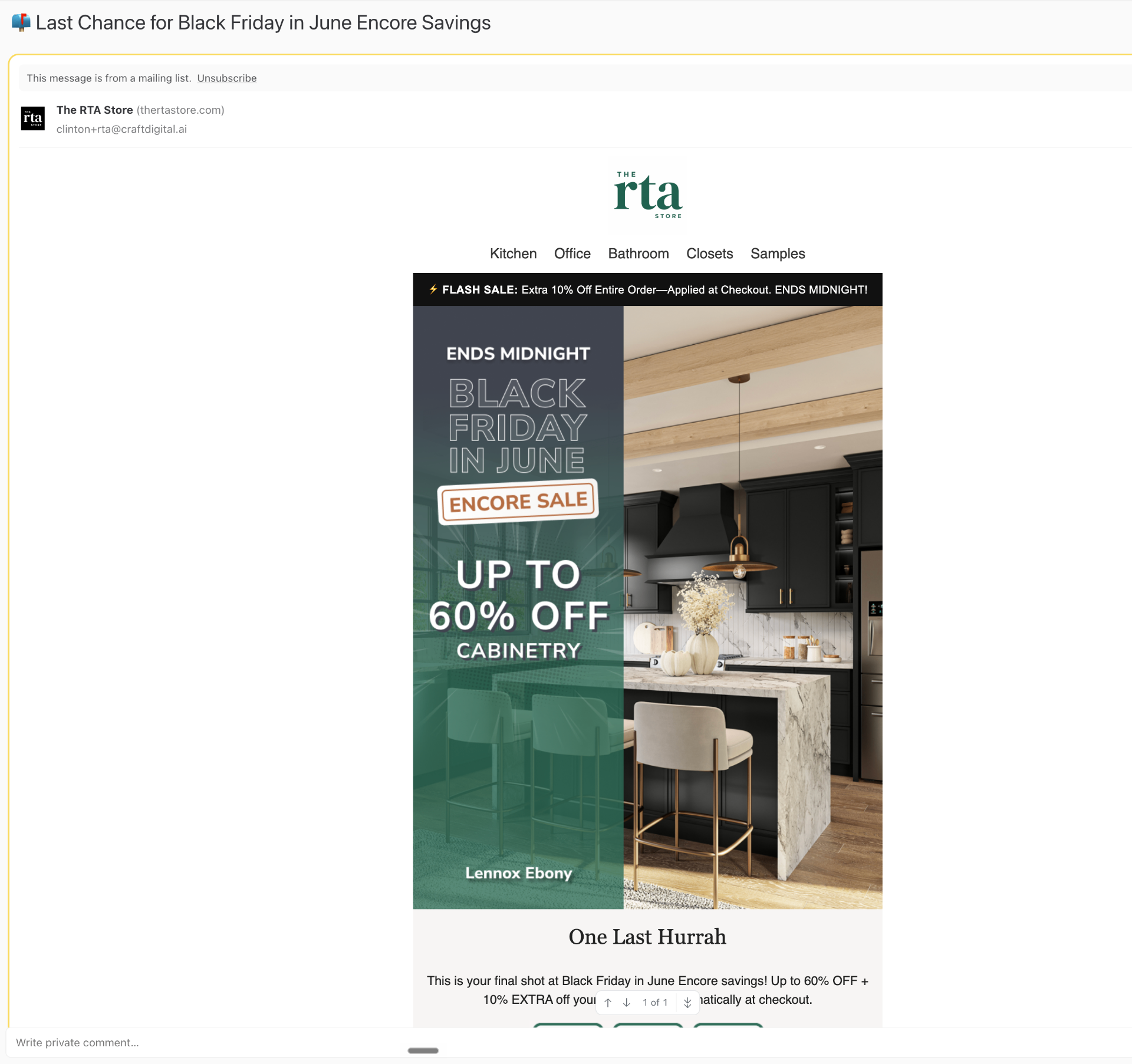
Last Chance for Black Friday in June Encore Savings
Promotion · up to 60% off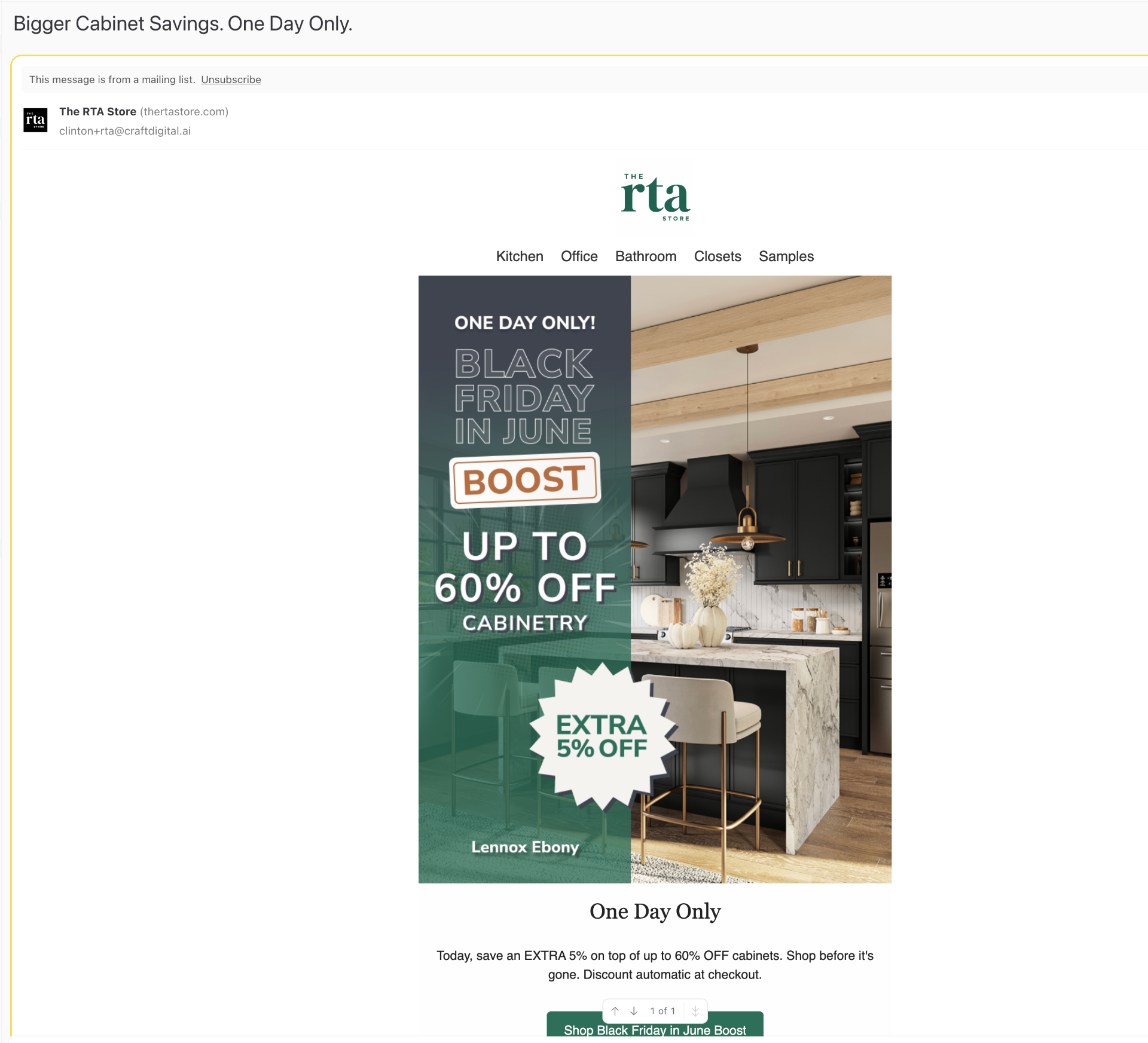
Bigger Cabinet Savings. One Day Only.
Promotion · up to 60% off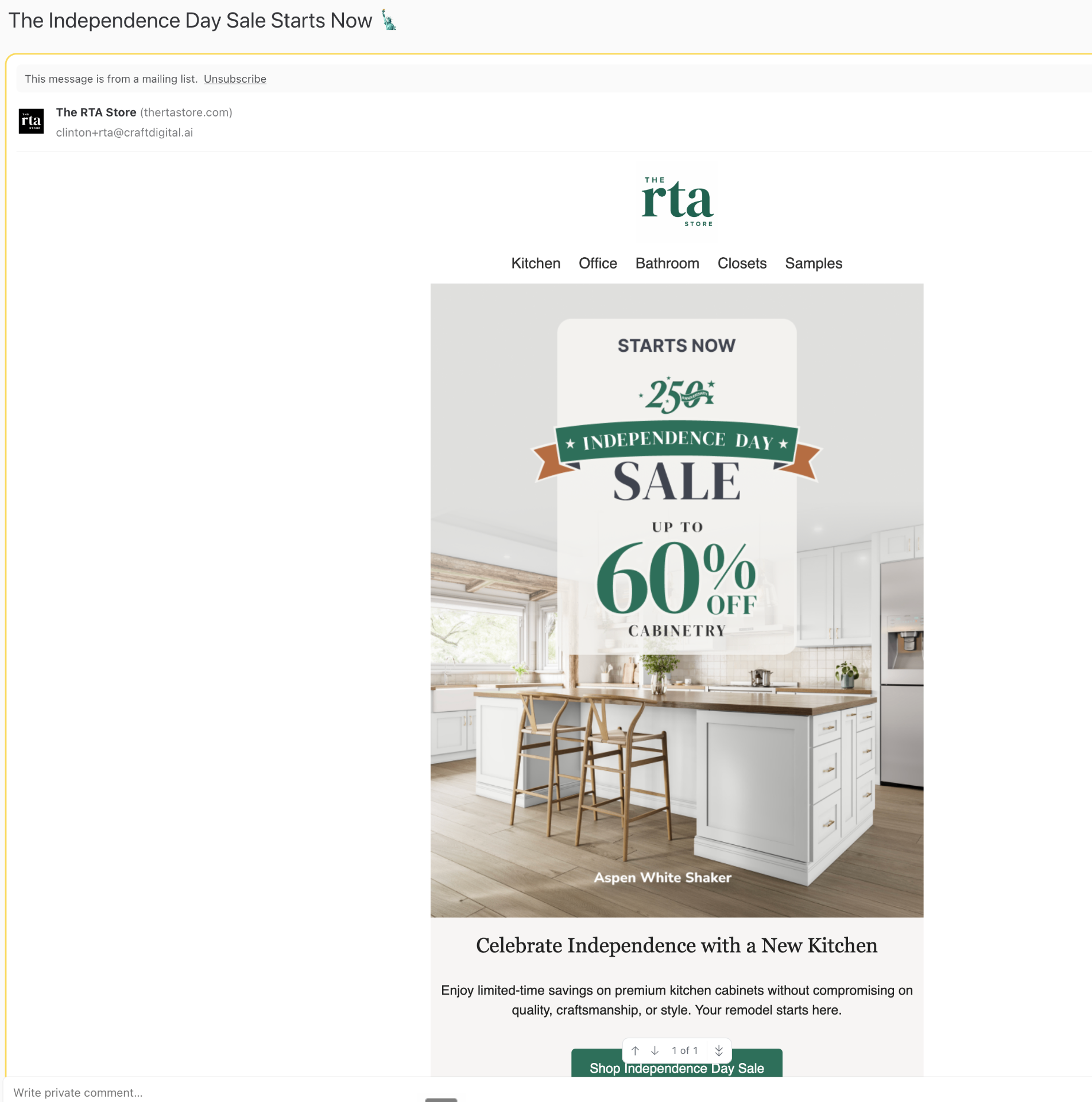
The Independence Day Sale Starts Now 🗽
Promotion · up to 60% off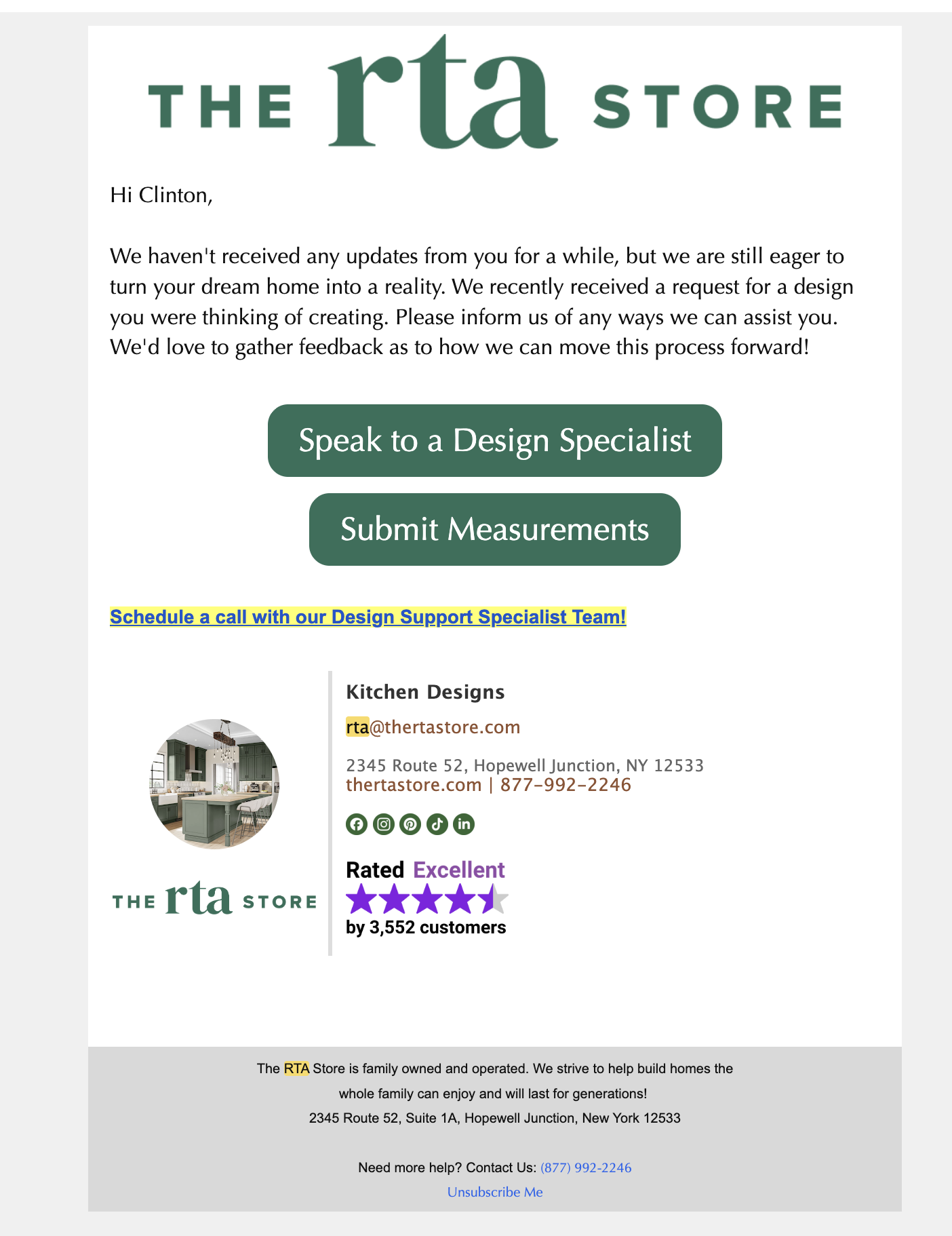
The RTA Store — let us know how we can help!
Relationship / design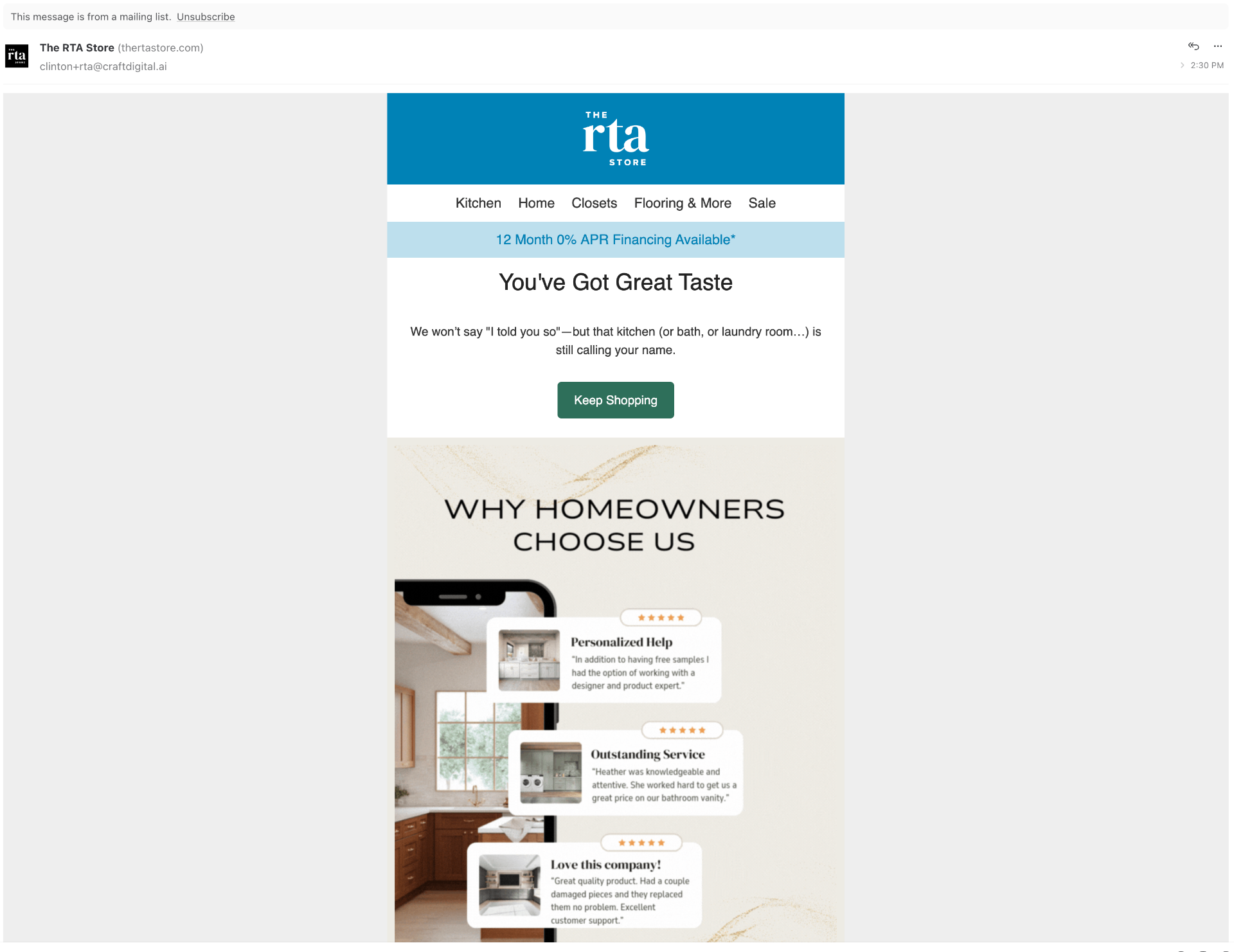
You've Got Great Taste
Relationship / designWhy this matters · Teams rarely step back and view their program the way a customer does — all at once. This is a partial capture, and more are still arriving. That's exactly the point.
Through the customer's eyes · what happens after the click
You earn the click. Then the page loses it.
The email is only half the story. The other half is what happens the instant someone clicks. I walked the exact path a '60% off' email sends a customer down — and this is where the redesign concerns from my original assessment come straight back. The site is beautiful. But there's so much to look at and do that the customer doesn't know where to go or what actually matters.
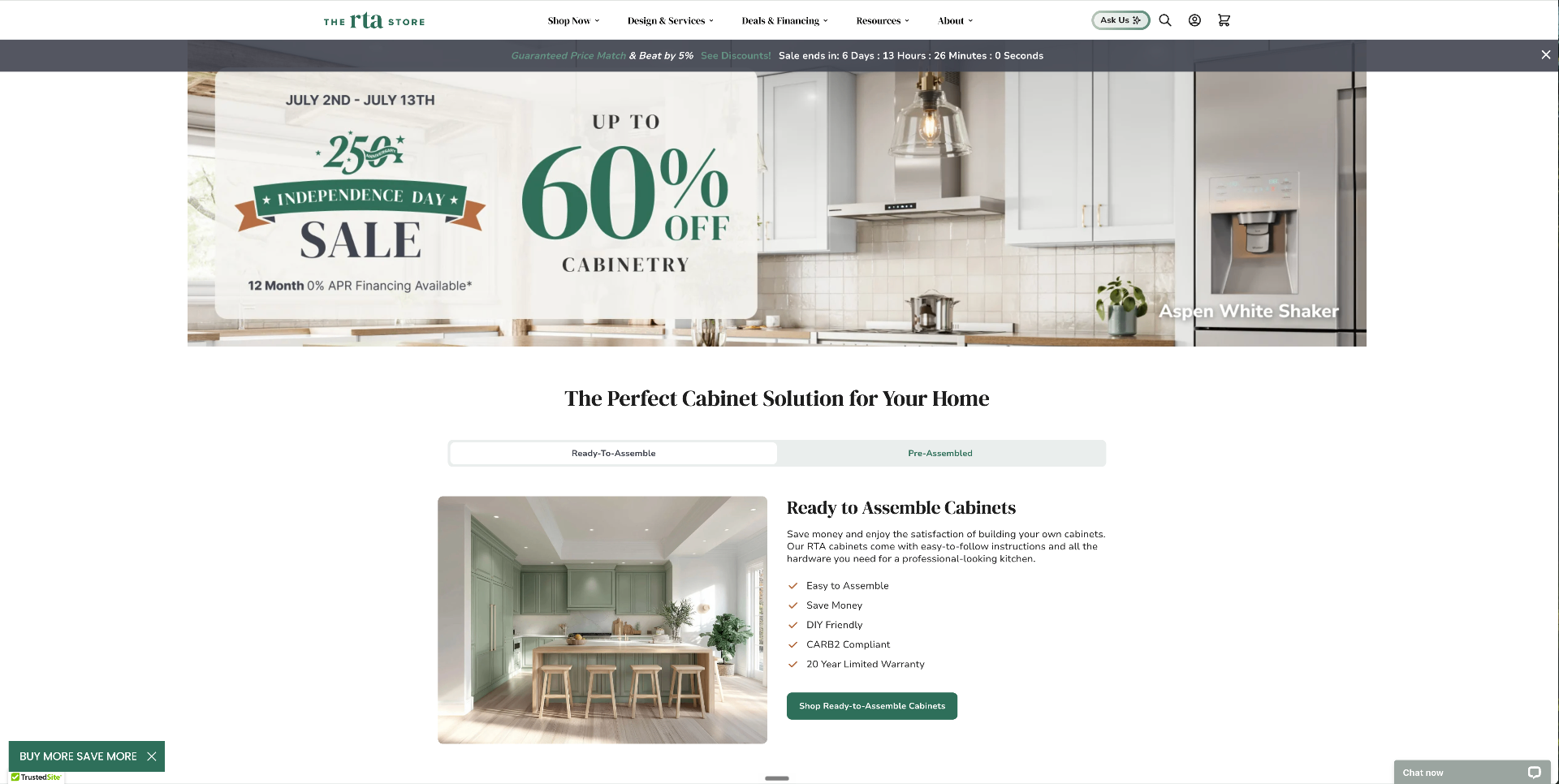
The email promises 60% off
A big, bold 'up to 60% off cabinetry' with a resetting countdown. The click is earned by the number.
Intent is highest right here.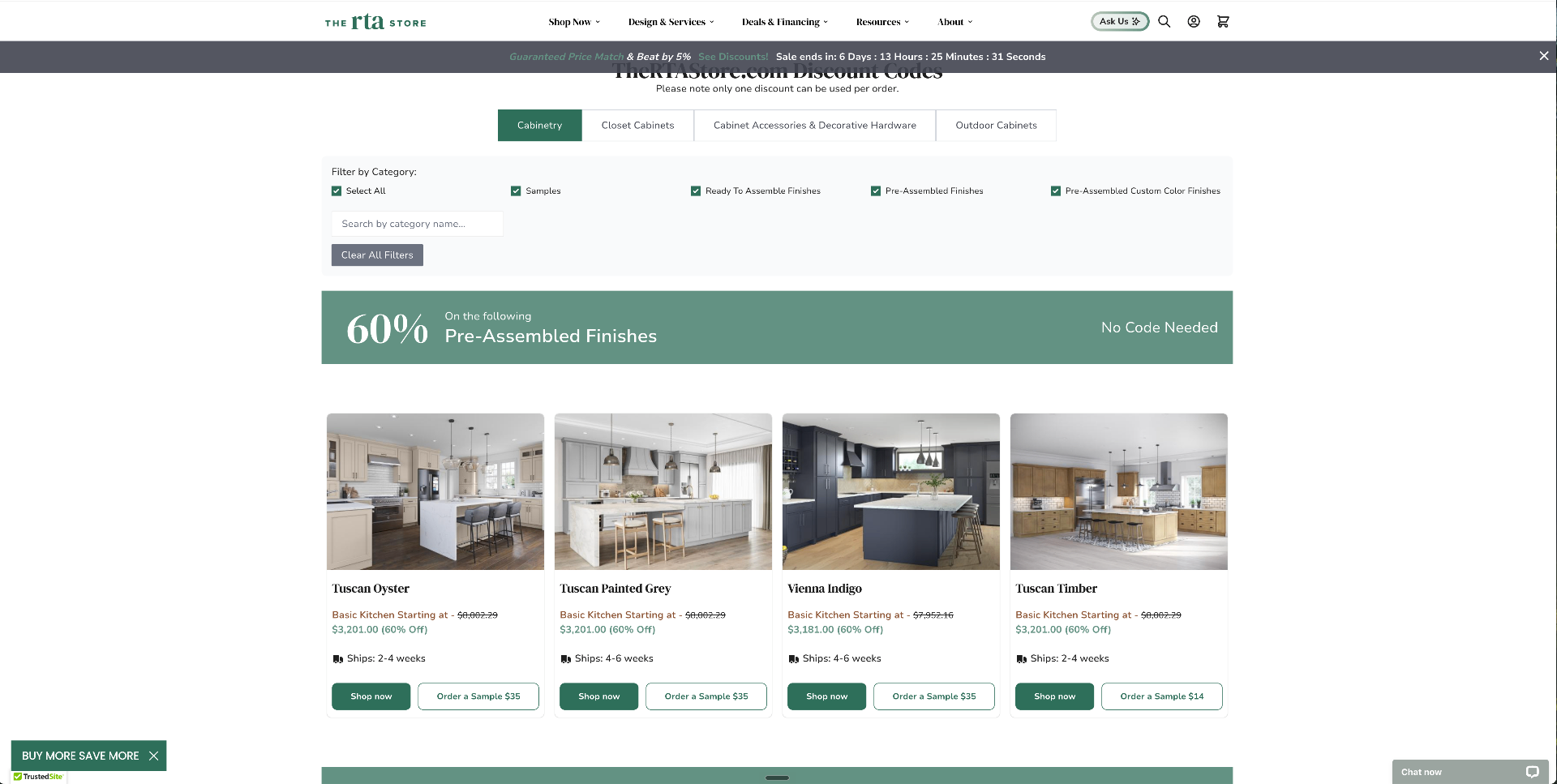
…but the click lands on an index
Instead of the promised deal, the customer hits a wall of discount codes — 60%, 50%, 45%, samples 70%, closets 40% — and has to decode which applies to them.
First click lost. Now they have to choose again.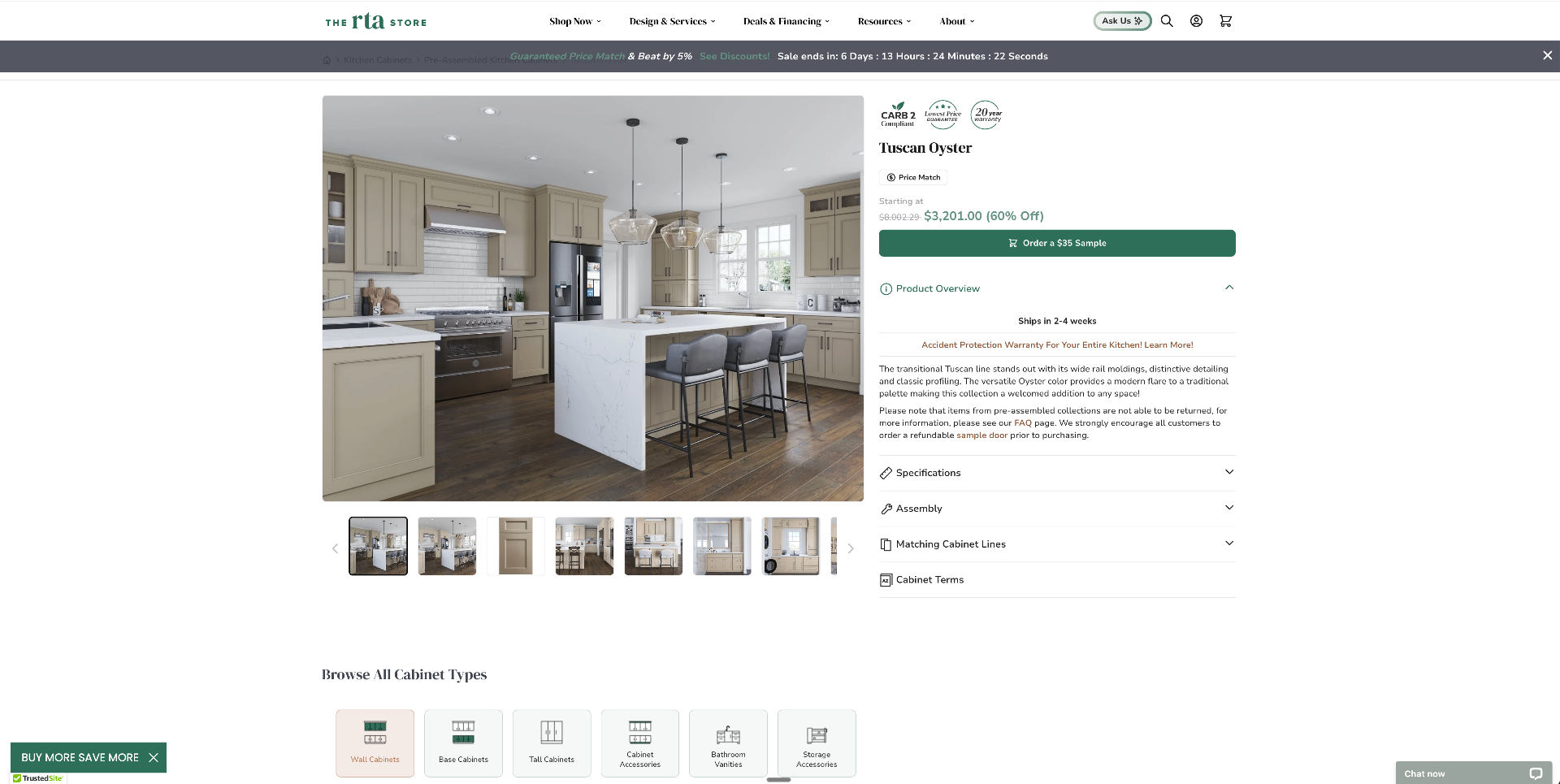
…then another click to a product
Only now do they reach an actual cabinet — buried under badges, tabs, a strike-through price, and an 'Order a $35 Sample' button competing with everything else.
Second click lost. The path never pointed anywhere on purpose.The math of the click
Traditional marketing rule of thumb: you lose roughly half your audience at every click. Send someone a 60%-off email, drop them on a general sale index, make them click again to a category, again to a product — and by the time they can act, most of the intent you paid to create is gone. If attribution is last-click, the email that started it all gets no credit for the sale it seeded, and the channel looks weaker than it is.
≈ 50% lost per click — so every extra step is half your intent, gone.
What's competing for attention on one screen
- A sale-countdown banner ("ends in 6 days…") stacked above a second "up to 60% off" hero — two urgency messages fighting each other.
- A mix of serif and sans, italic and roman, that makes it hard to tell what's actually most important.
- A fixed "Buy More, Save More" button in the corner that's bigger than the page's real CTA — and opens yet another pop-up.
- "Ask Us," search, account, cart, and a full mega-nav all shouting at once.
- The 60%-off creative is so loud it competes with the cabinets themselves — the product becomes the background.
The compounding cost · Every one of these is a reasonable idea on its own. Together, they overload the visitor and quietly compete with the single action you most want them to take.
Where should the click actually go?
The strategic question isn't 'how do we decorate the sale?' — it's 'what's the one thing we want this visitor to do?' The data across the funnel keeps pointing to the same answer: ordering a sample and working with a designer are the highest-value, highest-converting actions RTA has. So make the whole post-click path serve that.
If the email says 60% off, the click lands directly on that offer — the right products, pre-filtered — not a general index that makes them hunt. Every avoidable click is half your intent gone.
Cut the competing CTAs down to a clear hierarchy: one primary action, everything else demoted. Retire the pop-ups and the corner button that outshouts the real CTA.
Position a designer as the way to curate which sale items actually fit the customer's space and budget. The sale becomes the reason to talk to an expert — and the sample becomes the natural next step.
The real point · This isn't just an email or messaging problem. It's a conversion problem — and the email, the landing page, and the designer hand-off have to tell one coherent story for any of it to pay off.
Why this works against a high-consideration purchase
Four ways the discount treadmill quietly costs you.
A kitchen is a five-figure, months-long decision. The tactics built for impulse buys don't just underperform here — they actively erode the thing that actually closes the sale: confidence.
Resetting deadlines kill urgency — permanently
The first time a customer sees 'ends tonight' followed by a new sale the next morning, the clock loses all meaning. Worse: it's a one-way door. Once someone notices the deadline is fake, no future deadline works on them — including the real ones.
'Up to 60% off' becomes the price
When the discount is always on, it stops being a discount and quietly becomes the everyday price. Full price becomes unsellable, and there's no credible reference point left — so the 'deal' no longer creates any feeling of a deal. You've trained the customer to wait, then removed the reason to.
Discounting erodes trust on a five-figure decision
A kitchen is a months-long, high-consideration purchase. What buyers need is confidence, not pressure. Constant markdowns read as 'why is this so cheap?' rather than 'what a deal' — the opposite of what you want someone feeling before spending $8k–$12k.
Discounting the design service devalues the expertise
Your Platinum design service is the thing competitors can't copy. Putting it on sale ($99, was $300) tells customers your expertise isn't really worth its price — undermining the exact advantage the whole business should be built around.
The problem with "up to 60% off"
- Consumers anchor on the maximum number, then rarely find items actually at that level — the gap breeds distrust.
- Perpetual maximum-discount messaging reads as 'going-out-of-business,' not opportunity.
- With no items credibly at 60%, the headline over-promises and every product page quietly under-delivers.
Directional context — verify against RTA's own numbers
- JCPenney's 2012 shift to everyday pricing collapsed sales ~25% in a year — customers were conditioned to the 'sale' and stopped responding without it. A cautionary tale about deprogramming a discount-trained base.
- The FTC (US) and ASA (UK) both scrutinize 'up to X% off' claims when few or no items reach the advertised maximum — a compliance and credibility risk, not just a marketing one.
These are best-practice / consumer-research signals, cited as directional evidence. I'd want to confirm current sources before they land in a client-facing deck — and, more importantly, confirm them against your actual conversion and margin data.
A review of what RTA has presented
Credit where it's due — then the honest turn.
Your Email & SMS Marketing Rules document is thoughtful, and real effort went into it. It gets a lot right.
What it gets right
- ✓Sets sensible cadence and per-segment frequency caps
- ✓Names invalid urgency as a problem to avoid
- ✓Has rules for handling sale restarts
- ✓Addresses evergreen '60% off' messaging directly
- ✓Prescribes a healthier content mix
The honest turn
Real effort went into this — it's a thoughtful document. But it's a governance rulebook (how much, how often, what not to do), not a strategy (why, toward what, and what email is actually for). Constraints keep you from doing harm; they don't tell you where you're going.
- It pre-commits to "the goal is not to reduce promotions" — deciding the answer before asking the question.
- None of its numbers are grounded in RTA's actual performance data — the caps are reasonable guesses, not observations.
- It optimizes the promotion machine rather than asking whether email should be a promotion machine at all.
My response · the strategy that's actually missing
You're best at the one thing the emails ignore.
RTA's real, uncopyable advantage isn't price — and it isn't even cabinet quality. It's the design experience: a guided, human journey (Free vs. Platinum) that turns an overwhelming renovation into a confident decision.
Your highest-value conversions are emotional
Paid Platinum design and sample orders are trust-based, consideration-driven actions — the exact opposite of a discount impulse buy.
The current program optimizes for your weakest position
Price impulse is what commodity sellers win. It's the one game RTA is worst-positioned to dominate — and the whole email program is built around it.
…and neglects your strongest
Trust and expertise are what RTA is best-positioned to win, and email barely tells that story today.
The reframe
Email should be a relationship channel that happens to include promotions — not a promotion channel that occasionally remembers there's a relationship.
Better value ≠ a lesser experience
RTA's process — ready-to-assemble or pre-assembled, delivered to the door, designer-supported — is different from a showroom, not worse than one. The emails should prove that difference is a feature: expert design, real support, honest value. The customer isn't settling; they're being guided.
Best practices · what good looks like
Department-driven today. Customer-driven tomorrow.
The same discipline that makes a considered purchase feel safe also makes email measurable. Here's the shift, line by line.
What the journey should actually look like
One road, not six departments shouting.
You've joined the RTA family — here's the road we'll take you down. One road, not six departments shouting. Each stage has one message, one next step, and one way we know it worked.
Behaviorally realistic · This isn't a tidy linear funnel — real people stall, go cold, or order samples without booking design. Each stage carries a branch for exactly that, so the journey behaves like people actually behave.
Sample emails · the way we'd do it
What the new voice sounds like.
Four emails demonstrating the approach — three relationship touches and one honest, well-earned promotion. Each carries a single objective and a single way to measure it.
Hi there —
When you design a kitchen with us, you're not filling out a form and hoping. You're paired with a real designer (hi, that's me) who learns your space, your budget, and what you're actually trying to pull off.
Our customers tell us the design team is the best part — reworking layouts until it's right, catching the details, finding savings without cutting corners.
No pressure and no cost to start. Want to see what we'd do with your room?
There's a myth that a lower price means a lesser cabinet. With us, it's the opposite — and the reason is the model, not the material.
Real plywood construction. KCMA-certified quality. A 20-year warranty. We skip the showroom markup and ship ready-to-assemble (or pre-assembled, your call) straight to your door.
Same beautiful, durable kitchen — designed with expert help — for thousands less. That's the whole idea.
Choosing a finish from a screen is a leap of faith. It shouldn't be.
Order real wood door samples — actual finishes, textures, and construction — starting at $10 (and free with Platinum design). Set them on your counter, look at them in your light, live with them for a day.
That's the moment most people stop wondering and start planning. No deadline, no pressure — just confidence.
You've been designing with us, so you get first look: our Memorial Day event is genuinely our best pricing of the season.
It runs through Monday at midnight — and unlike our usual, this one actually ends. No 'extended,' no encore next week. If you've been waiting for the right moment on a kitchen you already love, this is it.
Not ready? That's completely fine. Your designer and your quote will be right here.
The question nobody's answered
Why are there so many sales?
Let me name the thing directly, because the existing rules never do. Since I subscribed, there hasn't been a single moment without a sale — all of June, into July, one event immediately following the last. The rulebook governs how to space sales. It never answers the question underneath all of them: why is there a sale every week in the first place? Until that's answered, no cadence rule really matters.
The question that comes first
“Why is there a sale every week?”
There are three honest possibilities. This is a decision for RTA to make deliberately — not an accusation. Pick the one that's actually true, and the right strategy follows from it.
It's a defined sale season
If summer is genuinely a promotional period, then own it as one cohesive season — a clear beginning, middle, and end, with named chapters — instead of a string of disconnected 'urgent' events that each pretend to be the last.
→ Then frame it as a season, not a series of fake finales.
The discounts are effectively permanent
If the deal is always on, this isn't a sale — it's the pricing model. It should be messaged as honest everyday value, not manufactured urgency.
→ Then commit to everyday value (see 9d).
The sales are reactive
Launched to hit short-term revenue with no plan — which is what a wall-to-wall calendar tends to signal. It's the pattern most worth being honest with yourselves about.
→ Then the current approach is the symptom, not the strategy.
Keeping myself honest · My hunch is it's mostly the third — but I don't know your internal reason, and it's genuinely yours to answer. I'd rather hand you the question and let the honest answer speak for itself.
If you're going to sell often, tell people why
Sale fatigue comes from sameness and silence — not frequency alone.
Subscribers can tolerate frequent emails if each one is genuinely different and the frequency has been honestly explained. What kills engagement is the same offer, repeated, with no stated reason. So if you're going to sell often, tell people why.
Turn the weakness into the brand's rhythm
If the real reason for frequent deals is RTA's enormous product breadth — many categories, collections, finishes, and price points — then say exactly that to the subscriber. The breadth stops being an excuse for noise and becomes the honest rhythm of the relationship.
Then, forward · This honesty only works if the sales then actually look and feel distinct by category and purpose — which is exactly what the promotional calendar and campaign-variety system deliver next. The explanation earns the frequency; the variety justifies it.
"You'll hear from us often — here's why. We carry a huge range, and we're always rotating real deals across different collections, so there's usually something for your project and your budget. Here's how to make the most of it."
Lean into the real, family-owned story. A short, warm founder video sets expectations up front and earns the frequency. Positioned early — right in the Welcome / 'what makes RTA different' stage of the journey.
Answering the cadence question you raised
On cadence: your caps are right. They're just not the whole answer.
You raised the cadence question directly in your Email & SMS Marketing Rules, so let me answer it just as directly. The frequency caps you've written are genuinely good guardrails — most of what follows is me agreeing with your own document. The one honest turn: a cap limits how loud the noise gets; it doesn't turn noise into a relationship.
Your segment caps — which I'd keep almost exactly
These are sound. My only edit: treat them as ceilings that need a reason to send, never quotas to fill.
The standard week you already defined
Two broad emails a week — one promotional, one that builds trust, teaches, or inspires. That single rule, actually followed, breaks the every-day-is-a-sale pattern on its own.
And the major-sale window, structured
5–6 broad emails across a 10–14 day event, never more than one a day, following a real arc: launch → category focus → trust / financing → mid-sale reminder → final 48 hours → true final day. Final-hours messages go to engaged and high-intent segments only.
Where the caps stop — and the strategy has to start
Here's the honest turn. Every cap in your document limits volume; none of them change what's inside the email. Cap the same 60%-off blast to twice a week and you've made the same problem quieter, not better — a customer who tunes out one identical sale tunes out a rationed one too. The caps are necessary. They are not the strategy.
A purpose per send, not a quota to hit
Your own rule says every campaign needs a defined purpose. Honor that and cadence takes care of itself — you send when there's a reason, not because a slot is open.
Real segmentation & suppression
The caps only work if active-order and low-engagement customers are genuinely suppressed, and high-intent shoppers get the tailored track. That's a data and list-hygiene commitment, not a calendar one.
Fill the mix you already prescribed
Your 40 / 30 / 20 / 10 split — promo, design & education, trust, inspiration — is exactly right. The journey and campaign-variety system are what actually fill the other 60%, so the cap isn't just 'fewer sales.'
Coordinate email and SMS
One broad promo across channels per 24 hours; SMS adds urgency or relevance, never repeats the email headline. Your document says this — it just needs to be enforced, not aspirational.
The bridge · So the cadence answer isn't a different set of numbers than yours — it's your numbers, plus the thing they're missing: something worth sending inside every capped slot. That's what the calendar and journey are for.
The promotional strategy · sales with structure
Sales with structure, variety, and honesty
RTA is a promotional business — the answer can't be 'promote less.' It has to be 'promote with structure, variety, and honesty.' Right now every sale is the same 60%-off message in a different costume, so no single sale feels special. The fix is a planned calendar where each event has a real reason to exist, a distinct angle, and its own creative identity.
The annual promotional calendar
Illustrative · This calendar is illustrative — a strawman to react to, not a plan decided for you. The specific events, margins, and which categories could move to everyday value are RTA's calls. Let's build the real one together.
New-year renovation intent is at its peak
Free design + 0% financing spotlight
New & re-engaged subscribers
Convert planners into guided projects
Bonus Platinum value (extra room / credit)
Free-design users, samplers
Spring project season begins
Featured finishes & collections
Browsers by style interest
Genuine seasonal sale with a real deadline
Best pricing of the season — actually ends
Engaged / high-intent
Drive the tactile micro-conversion
Free / credited samples toward purchase
Undecided leads
Real holiday hook, distinct creative
Time-boxed holiday pricing
Full list, capped frequency
Pre-holiday renovation push
Discounted / bonus Platinum design
Planners, stalled designs
Move big-ticket without cutting price
0% APR up to 12 months (orders $2,500+)
Quoted, cart-stage
The ONE genuinely biggest event — deep discounts earn credibility by being rare
Year's deepest, true-deadline discount
Full list
Close the year on payments, not markdowns
0% APR push + design for the new year
Warm leads, cart abandoners
Different sales, treated differently
A customer who sees the same offer repeatedly tunes out. A customer who sees genuinely different value propositions stays engaged. Each of these should look and feel like its own event in the inbox — different creative, different hero, different story.
Cabinet discount sales
The traditional offer — but reserved and rationed so it stays credible.
Creative · Bold, urgent, product-forward. Used sparingly.
Sample sales & incentives
Drive the tactile micro-conversion: free or credited samples toward purchase.
Creative · Tactile, sensory, confidence-first — not price-first.
Design-service promotions
Discounted or bonus-value Platinum — positioned around outcome, never 'expertise on clearance.'
Creative · Human, expertise-led, outcome-focused.
Financing events
0% APR as the hero — drive big-ticket purchases without cutting price or eroding the anchor.
Creative · Empowering, practical, aspirational.
Bundle / project savings
Whole-kitchen or full-room packages — value framed as completeness, not clearance.
Creative · Room-scene led, 'your whole kitchen' framing.
Seasonal / holiday
Genuine calendar hooks that give a real reason to act now.
Creative · Distinct per holiday — its own hero, its own story.
How to introduce a sale
Announce the event & the real end date. Full list, capped.
AllSpotlight specific collections / finishes.
By interestWhy buy now — support, warranty, 0% APR.
EngagedOne honest nudge. Not a new sale.
Non-openersGenuine urgency — engaged & high-intent only.
High-intentIt actually ends. No encore tomorrow.
High-intentThe rule · One broad email per day, maximum. Final-hours messages go only to engaged / high-intent segments — not the whole list. Contrast this with today's 'same message, every day, to everyone.'
The everyday-pricing question
If 'up to 60% off' is available nearly year-round, then it isn't a sale — it's the pricing model. The brand should decide, deliberately, which it is. This is a question for RTA, not a verdict from me.
Honest everyday value
Certain core categories are simply priced at their real everyday price — 'everyday cabinet value,' 'always-affordable collections' — with evergreen messaging instead of fake urgency. Real sales then become rare and genuinely exciting.
True high-low
Maintain a credible full price and run real, time-boxed discounts that actually end — which requires the discipline to sell at full price between events.
The trap you're in now · The current approach is the worst of both: the permanence of Path A with the fake-urgency theater of Path B — so it earns the credibility of neither.
A way through · My suggestion: a hybrid — an everyday-value tier for core categories, with reserved, genuine sale events for the rest. This is a pricing/margin decision only RTA's data can settle — which ties straight back to the data request.
The honest caveat + the ask
I'd rather be proven wrong by your data than right in a vacuum.
The honest caveat
This is a hypothesis built from experiencing the funnel from the outside. If your numbers show the current approach genuinely converts and builds long-term value, then that's what matters — and I want to see it. I'd rather be proven wrong by your data than be right in a vacuum.
What I'd love to see — by segment, last 90 days
- →Open & click trends over time
- →Conversion rate
- →Unsubscribe rate
- →Spam-complaint rate
- →Revenue per recipient (not gross)
- →Email-to-sample conversion
- →Email-to-quote conversion
- →Email-to-Platinum conversion
- →Funnel drop-off between each journey stage
None of this is a critique of effort — it's an invitation. You've built something customers genuinely love (your reviews prove it). Let's make the email program tell that story. I'd love to walk through this together and build the real calendar and journey with your data in the room.
Clinton
For Tyler & the RTA Store team